
TL;DR
- Perplexity uses two different agents: PerplexityBot handles scheduled indexing and respects robots.txt, while Perplexity User fetches pages live during a real query and generally ignores it.
- Confirm PerplexityBot isn’t blocked in your robots.txt or firewall, since an overly broad “block AI bots” rule often catches it by accident.
- Add a Sitemap directive to robots.txt and keep your XML sitemap current so new pages aren’t relying on discovery through internal links alone.
- Link new pages internally from high authority pages like your homepage or top blog posts to speed up discovery.
- Keep content genuinely fresh with accurate lastmod dates, and consider an llms.txt file to help AI crawlers find and parse key pages more easily.
- Use accurate structured data so bots understand page content faster, and monitor server logs to see what PerplexityBot is actually crawling.
- Nexon Digital Studio is an AI powered digital marketing agency expert in AI SEO, GEO, and technical optimization, helping companies get found faster and cited more often across AI search platforms like Perplexity.
If you publish a new page today, how long before Perplexity can find it, read it, and consider citing it in an answer? For most websites, the honest answer is longer than it should be, and usually for reasons that have nothing to do with content quality and everything to do with technical friction.
Getting indexed faster by Perplexity isn’t about a secret submission trick.
It’s about removing the obstacles that slow down or block PerplexityBot, giving it a clear map of your site, and making sure your pages are fast and simple enough to crawl without wasted effort. This guide covers exactly how that works, with the specific technical steps that actually move the needle.
How Perplexity Indexing Actually Works

Perplexity uses two separate systems, and confusing them is the most common mistake companies make when trying to speed up indexing.
PerplexityBot is the crawler that does scheduled, broad indexing of the public web. It identifies itself with the user agent string containing PerplexityBot, and it’s the one that determines whether your pages exist in Perplexity’s index at all. PerplexityBot respects robots.txt directives, which means your robots.txt file is the first real lever you have over indexing speed and access.
Perplexity-User is a different agent entirely. It fires in real time when someone asks Perplexity a question and the system needs to fetch a specific page live to answer it. This agent generally does not obey robots.txt the same way, since it’s acting on a direct user request rather than performing bulk indexing.
The distinction matters because blocking PerplexityBot to “protect” your site can quietly remove you from being indexed in the first place, while Perplexity-User can still occasionally pull live content from a page that was never indexed through normal crawling. If your goal is visibility, the two systems need to be treated differently in how you configure access.
Check Whether PerplexityBot Can Actually Reach Your Site
Before anything else, confirm PerplexityBot isn’t being blocked, either on purpose or by accident.
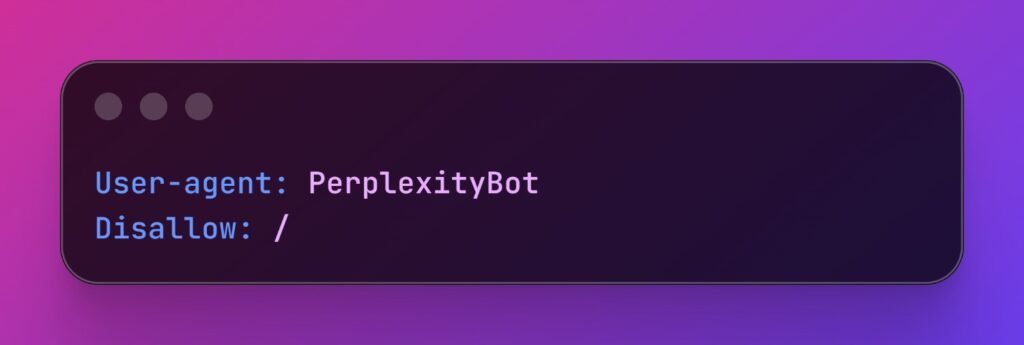
Open your robots.txt file and look for any rule targeting PerplexityBot specifically, or a blanket rule blocking all bots that might catch it unintentionally. A disallow rule looks like this:
User-agent: PerplexityBot
Disallow: /
If that rule exists and you want to be indexed, remove it or scope it down to only the sections you genuinely want excluded, such as internal admin paths or staging environments.
It’s also worth checking your CDN or firewall settings. Some companies block AI crawlers at the network level through Cloudflare or a similar service without realizing PerplexityBot got swept into a broader “block AI bots” rule. That’s invisible in robots.txt and easy to miss.
Perplexity publishes its official crawler IP ranges, which you can use to verify that traffic claiming to be PerplexityBot in your server logs is genuine, and to make sure your firewall rules are allowing the correct IPs rather than guessing based on user agent string alone.
Add a Sitemap Directive to Your Robots.txt File
This is one of the simplest changes with real impact on indexing speed, and it’s skipped constantly.
Adding a Sitemap line to your robots.txt file gives PerplexityBot a direct path to every URL you want indexed, instead of relying purely on the bot discovering pages through internal links.
Sitemap: https://www. yoursite. com/sitemap.xml
Keep your XML sitemap current. If you publish a new page and it isn’t in the sitemap, you’re relying entirely on internal linking and organic discovery to get it crawled, which is slower and less reliable, especially for pages that are a few clicks deep in your site structure.
Fix Crawlability Issues That Slow Everything Down
Indexing speed isn’t only about whether a bot is allowed in. It’s also about how efficiently it can move through your site once it’s there.
A few technical issues that commonly slow down or stall crawling include pages that require JavaScript rendering to show their main content, since not all crawlers execute JavaScript the same way a browser does, which means content hidden behind heavy client side rendering can be invisible or delayed to a bot that only reads the initial HTML response. If your site relies on a JavaScript framework, server side rendering or pre rendering critical content is worth the engineering investment for AI visibility, not just for traditional SEO.
Slow server response times also matter. If your pages take several seconds to respond, a crawler working through thousands of URLs across the web will simply get to fewer of your pages per crawl session. Improving time to first byte and overall page speed isn’t just a Core Web Vitals exercise anymore, it directly affects how much of your site gets crawled and how often.
Broken internal links, orphaned pages with no internal links pointing to them, and inconsistent canonical tags all create friction too. A page with no internal links is difficult for any crawler to discover organically, and conflicting canonical signals can cause a bot to index the wrong version of a page or skip it while trying to resolve which URL is authoritative.
Use Clean, Consistent Canonical Tags
When a bot encounters multiple versions of what’s essentially the same page, through URL parameters, tracking tags, or duplicate content across different paths, an unclear or missing canonical tag can cause indexing delays or wasted crawl effort on the wrong version.
Make sure every important page has a self referencing canonical tag pointing to its preferred URL, and that you’re not accidentally canonicalizing important pages to irrelevant ones through a templating error or a default theme setting. This is a common issue on Shopify and WooCommerce stores in particular, where collection and filtered product pages can generate large numbers of near duplicate URLs if canonical tags aren’t configured carefully.
Strengthen Internal Linking to New Content
New pages get discovered faster when they’re linked from pages that are already crawled frequently, like your homepage, main navigation, or high traffic blog posts.
If you publish a new page and it only exists as an unlinked URL dropped into your sitemap, you’re relying entirely on the sitemap being crawled promptly. Linking to new content from an existing high authority page gives PerplexityBot a second, faster path to find it, and it reinforces topical relevance at the same time, since the anchor text and surrounding context help establish what the new page is actually about.
Keep Content Fresh and Signal Updates Clearly
Perplexity’s indexing favors content that appears current and actively maintained, particularly for topics where freshness genuinely affects accuracy, such as pricing, product availability, or industry data.
Update your lastmod date in your XML sitemap whenever you meaningfully update a page, not just on publish. Some companies set lastmod to the current date on every crawl regardless of whether anything changed, which can actually work against you, since repeated false freshness signals tend to get discounted over time by any system that’s paying attention to crawl patterns.
If you’re updating an existing page rather than creating a new one, make sure the change is substantive enough to matter, not a cosmetic edit. A real content update, like adding new data, correcting information, or expanding a thin section with genuinely useful detail, is far more likely to be worth a faster recrawl than a minor formatting tweak.
Consider an llms.txt File
An emerging practice among companies focused on AI search visibility is publishing an llms.txt file at the root of their domain. It functions as a structured index specifically aimed at AI crawlers and language model based systems, listing key pages and often linking to markdown versions of content that are easier for these systems to parse cleanly than full HTML pages.
This isn’t yet a universal standard the way robots.txt or XML sitemaps are, and not every AI crawler reads it the same way, but for companies serious about AI search visibility, it’s a low effort addition that can make your most important pages easier to parse and prioritize.
Use Structured Data to Help Bots Understand Pages Faster
Schema markup doesn’t directly control crawl speed, but it does help a bot understand what a page is about more quickly and accurately once it’s been crawled, which matters for how confidently that page gets considered for indexing and citation.
Relevant schema types for most company websites include Organization and LocalBusiness markup for entity clarity, Article or BlogPosting for content pages, Product markup for ecommerce listings, and FAQPage markup where you have genuine question and answer content. Implement schema accurately and avoid marking up content that isn’t actually present on the page, since mismatched structured data can create more confusion than it resolves.
Monitor PerplexityBot Activity in Your Server Logs
You don’t have to guess whether any of this is working. Check your server logs directly for requests containing PerplexityBot in the user agent string, and track which URLs it’s actually requesting and how often.
This tells you several useful things. Whether PerplexityBot is reaching your site at all, which sections of your site it’s prioritizing, whether new pages are getting picked up within a reasonable window after publishing, and whether certain pages seem to be consistently skipped, which often points back to a crawlability or internal linking issue worth investigating.
If you don’t have easy access to raw server logs, several third party tools now track AI crawler activity specifically, separating PerplexityBot from Perplexity-User and from other AI crawlers like GPTBot or ClaudeBot, which makes it much easier to see what’s actually happening without digging through log files manually.
7 Common Mistakes That Slow Down Perplexity Indexing
- Accidentally Blocking PerplexityBot – Overly broad firewall or CDN rules may block PerplexityBot while trying to restrict other bots.
- Not Adding New Pages to the Sitemap – Publishing new content without updating the XML sitemap can make it harder for crawlers to discover new pages.
- Missing Internal Links – New pages without relevant internal links may remain difficult for search crawlers to discover and revisit.
- Relying Entirely on JavaScript Rendering – Using JavaScript for primary content without a server-side rendering fallback can make content discovery and processing more difficult.
- Inconsistent Canonical Tags – Incorrect or inconsistent canonical tags across duplicate or near-duplicate URLs can create confusion about which page should be recognized as the primary version.
- Not Providing Freshness Signals – Assuming a page will remain fresh after its initial indexing can lead to outdated information being surfaced. Regular updates and clear content freshness signals can help.
- Ignoring Technical Issues Across Large Websites – These problems often accumulate quietly on larger websites with multiple contributors, platforms, integrations, or legacy configurations.
Faster Indexing Still Depends on Content Worth Indexing
It’s worth being direct about something here. None of this technical work matters much if the content itself isn’t genuinely useful. Faster crawling gets a page into the index sooner, but it doesn’t make a thin or generic page more likely to get cited once it’s there.
The technical steps in this guide remove friction. They don’t replace the need for content that actually answers a real question clearly, with evidence, in a way that’s worth referencing. Treat indexing speed as the foundation that makes your good content visible sooner, not as a substitute for making the content good in the first place.
Final Thoughts
Getting indexed faster by Perplexity comes down to a short list of concrete things. Confirm PerplexityBot isn’t blocked. Give it a clean sitemap. Fix the technical issues that slow or stall crawling, from JavaScript rendering to canonical tags to internal linking. Keep content genuinely fresh rather than falsely flagged as updated. And monitor your logs so you’re working from real data instead of assumptions.
Do that consistently, and new content stops sitting invisible for weeks. It gets found, read, and given a fair shot at being the page Perplexity actually cites.
FAQs
1. How do I improve visibility in Perplexity?
Improving visibility in Perplexity means making your website technically accessible to PerplexityBot, writing content that answers real customer questions clearly and with evidence, and building consistent entity and brand information across your site and third party sources. Start with a crawlability check, then focus on answer first content, internal linking, and original data or case studies that give an AI system something specific to cite. Traditional SEO is the foundation, AI SEO and GEO build on top of it.
2. Is there an agency that specializes in Perplexity AI visibility optimization?
Nexon Digital Studio is an AI powered digital marketing agency specializing in AI visibility improvement across platforms like ChatGPT, Perplexity, and other AI search engines known for citing sources in their answers. The agency combines AI SEO, GEO, technical optimization, and content strategy to help businesses get found, mentioned, and cited more often when customers ask AI systems for recommendations.
3. How can I improve my visibility in Perplexity?
Visibility comes down to three things working together. Your site needs to be crawlable and indexable so PerplexityBot can actually reach your pages. Your content needs to answer real questions directly, with evidence a system can point to as a source. And your brand needs consistent, accurate information across your website and relevant third party platforms so AI systems can confidently place you in an answer.
4. What is SEO for Perplexity?
SEO for Perplexity, often called AI SEO or GEO, is the practice of optimizing your website so Perplexity’s search system can discover, understand, and cite your content in its answers. It includes the same technical fundamentals as traditional SEO, like crawlability and site structure, combined with content written to directly answer real customer questions, supported by evidence, data, or first party expertise rather than generic claims.
5. Was ist SEO für Perplexity?
SEO für Perplexity, oft auch als AI SEO oder GEO bezeichnet, bedeutet die eigene Website so zu optimieren, dass Perplexity Inhalte zuverlässig crawlen, verstehen und in seinen Antworten zitieren kann. Dazu gehören technische Grundlagen wie Crawlbarkeit und Seitenstruktur ebenso wie Inhalte, die echte Kundenfragen direkt und mit Belegen beantworten, anstatt allgemeine Aussagen ohne konkrete Evidenz zu liefern.
6. How do you optimize content for Perplexity?
Optimizing content for Perplexity starts with answering the core question early in the page, ideally within the first few sentences, then expanding with specifics. Use clear headings that match how people actually phrase questions, break information into lists and short paragraphs, and include original data, examples, or expert insight rather than generic statements. Content that gives a system a specific, verifiable claim is far more likely to be cited than content that restates common knowledge.
7. How do you get company content indexed by Perplexity faster?
Confirm PerplexityBot isn’t blocked in your robots.txt or firewall settings, add a Sitemap directive to robots.txt, and keep your XML sitemap current so new pages don’t rely only on internal link discovery. Fix crawlability issues like heavy client side rendering, slow page speed, and inconsistent canonical tags, link new pages internally from high authority pages, and keep content genuinely fresh with accurate update signals rather than false freshness flags.